
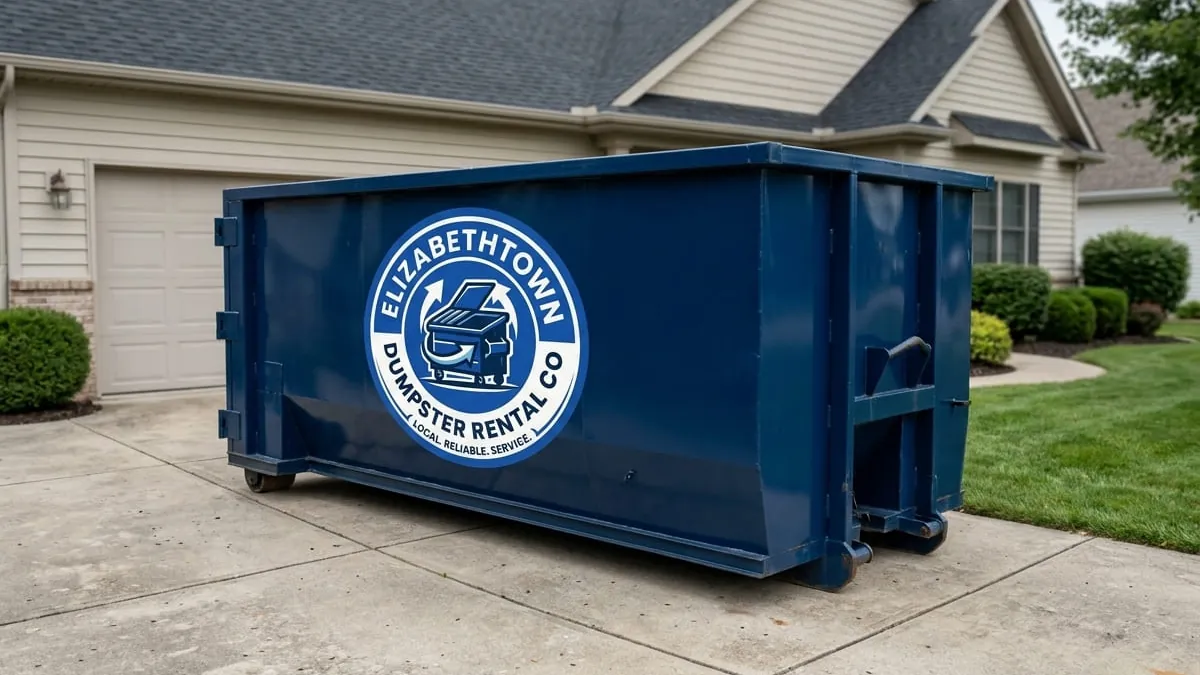
Elizabethtown, KY · Hardin County
Roll-Off Dumpsters in Elizabethtown — and a Straight Answer About Whose Rules Apply
10 through 40 yard containers across Elizabethtown and Hardin County, at one flat figure with the disposal already inside it. In this county the hard part of the call is rarely the box — it is that four different governments could be the answer to your question, and a city line decides which one. We will tell you which, and give you its phone number. Locally owned since 2012.
- One flat figure, disposal included
- Plywood under the wheels and both rails
- We name the desk that answers
- Same-day where the board allows
Flat-rate, all-in pricing· Disposal in the price· Hardin County since 2012
Why Elizabethtown Dumpster Rental
Why the phone gets picked up in Elizabethtown
Nobody rings a container company during an easy week. There is a report date in July and a garage that has to be empty before the movers come. There is a tenant out at the end of the month and six days to turn the unit. There is water that came up through a crawlspace in a wet spring, or a house somebody lived in for fifty years and a family with two weeks and a set of keys. None of it is improved by a hauler who quotes one figure on the telephone, bills another, and leaves the container sitting square across the mailbox on the way back out.
The first truck went on the road in 2012 and 14 years later the rule behind it is unchanged: say the real number out loud, then arrive on the day it was promised for. Wes Tharp still takes most of the morning calls and still keeps the dispatch board himself, and nobody on this fleet backs a container in without walking the drop on foot first.
We run out of 4675 N Dixie Hwy — our yard here in Elizabethtown, out on US 31W north of downtown — so nothing has to be routed in from another market when a container is wanted on the drive this afternoon. It is sitting on the lot already. And our own street happens to be the neatest illustration of what this whole site is about. Our address sits inside the Elizabethtown city limits. Keep going up the same road, in the same ZIP code, with the same mailing city printed on the envelope, and the addresses start coming back as Radcliff — and between the two there is ground that comes back as no incorporated place at all. One road, one ZIP code, three governments. The City publishes an “Am I in the City Limits?” map for exactly that reason, and it is two minutes well spent before you plan anything.
The city line matters here for a reason, and the reason is a lawsuit. Kentucky puts a duty on every one of its counties: under KRS 224.43-315 each county must “provide a universal collection program … for all municipal solid waste generated within the county,” whether by county collection, by contract, by franchise, by staffed convenience centers or by an approved alternative — and the same statute provides that “all persons providing collection service, including collection for the purpose of recycling, shall register annually with the counties.” Hardin County met that duty with a franchise, and the franchise draws its own boundary in its own words: the franchise area is “the unincorporated areas of Hardin County, Kentucky,” and the exclusive right is “limited to residential solid waste only.” It stops at the city line because in 1979 the Kentucky Court of Appeals said it had to, in a case brought by Elizabethtown, Radcliff and Vine Grove against the Hardin County Fiscal Court, which held that counties lack unilateral authority to franchise garbage collection inside city boundaries and that cities keep “power over collection of garbage within their limits.” We describe that decision rather than cite it, because we could not verify a reporter citation for it and we are not going to invent one. Inside the city the consequence is plain: the City of Elizabethtown does not collect household garbage at all. § 92.031(H)(1) lists the lawful methods and the first of them is “pickup and collection by sanitation companies, who possess a valid business license.”
So there are four desks in this market, and we publish all four rather than pretending there is one. Inside Elizabethtown it is the City — Planning and Development on (270) 765-6121, Public Works on (270) 737-7890, Fire on (270) 765-2121. Inside Radcliff, Vine Grove or any of the other cities it is that city’s own hall — Radcliff (270) 351-4714, Vine Grove (270) 877-2422 — and we do not assume Elizabethtown’s rules travel across a boundary, because nothing we read establishes what those cities require. In unincorporated Hardin County there is no city hall at all, and the permit desk is the Hardin County Planning and Development Commission on (270) 769-5479. On Fort Knox it is none of them: that is federal land, the installation sets its own rules, and city and county rules do not apply on post. And if any part of the job touches the right-of-way of a numbered route — US 31W, US 62, US 31E, I-65 or the parkways — that is a Kentucky Transportation Cabinet matter rather than a City one: KYTC District 4, 310 Valley Creek Road here in Elizabethtown, (270) 766-5146.
The state layer sitting above all that runs the opposite way from what a contractor moving in from elsewhere expects. Kentucky has one building code and the Commonwealth writes it. KRS 198B.050 requires a “mandatory Uniform State Building Code” establishing standards for “all buildings” in the state, adopted as the 2018 Kentucky Building Code (Fourth Edition, February 2024) at 815 KAR 7:120 and the 2018 Kentucky Residential Code (Third Edition, August 2024) at 815 KAR 7:125, both effective 3 December 2024. Elizabethtown does not have a building code of its own; it enforces the Commonwealth’s. What the statute leaves to your town is the interesting half. KRS 198B.060(8) provides that nothing in it requires a single-family dwelling to be permitted or inspected “unless a local government has established a building inspection program” — and Elizabethtown established one and wrote it to reach houses expressly: § 150.01(C) establishes an inspection program “for application to all buildings, including single-family dwellings.” As published in the City’s code, a residential demolition permit is $50 and a commercial one $100; fee schedules move, so confirm the current figures with Planning and Development before you budget against them. Fire is the second reversal, and it is bigger. Kentucky does not use the model fire code most states adopt. The Kentucky Standards of Safety at 815 KAR 10:060 adopt NFPA 1, Uniform Fire Code, 2018 edition, whose combustible waste and refuse provisions sit in Chapter 19 — and § 2(1) of that regulation says it “shall apply to all buildings except one (1) and two (2) family dwellings.” A container on a driveway at a house is not something the state fire code reaches at all. Against a store, a restaurant, a warehouse or an apartment building it is, and the people who will actually come and look at it are Elizabethtown Fire Prevention on (270) 765-2121. We do not publish a separation distance for Kentucky, because we could not verify one.
The City does run three free collection programs, and every one of them is written to exclude precisely what a project makes. The 2026 Spring Clean-Up is published as “MARCH 30th THRU MAY 1st — JUNK AND DEBRIS,” with appliances collected on call-in from 27 April to 1 May, and the collection zones are drawn west and east of US 31-W and north and south of KY 1357 or KY 251 — which is to say they are drawn off our own street. The refusal list is the City’s own sentence: “No garbage, hazardous materials, liquids (paints, oil, antifreeze, etc.), construction debris, tires, or automobiles.” Brush collection takes only “debris resulting from trees and shrubs which have been pruned or trimmed,” “less than twelve (12) inches in diameter and/or five (5) feet in length,” on a four-week rotating schedule, and it expressly does not include debris from “the clearing of land.” Then there is the line that settles the argument for anyone doing this for money: “Licensed contractors must remove and dispose of debris from their own work professionally.” Leaf pick-up is a fall program, bags under fifty pounds, and it asks you to keep brush and debris out of the leaf piles. Those dates move every year — the ones above are as the City published them for 2026 — so confirm current dates with Public Works, (270) 737-7890 rather than with us.
And the county route for the awkward material is annual, which is the whole problem. Hardin County holds a household hazardous waste collection event once a year and an electronics recycling event once a year. Its seven drop-off locations — Eastview, Elizabethtown, Farmers Market, Glendale, Radcliff, Sonora and Vine Grove — are open around the clock, but they take four narrow streams and nothing else: rinsed #1 and #2 plastics, rinsed aluminum and tin, non-greasy cardboard, newspaper. The county’s own line is “items not listed above are not accepted at any drop-off location.” Clear a house out in March and the hazardous waste day may be months off, and you have nowhere to put the paint. That is a real gap, we say so on the phone rather than after the fact, and County Solid Waste is (270) 360-9207.
The housing is old enough to keep this trade steady, and the tenure map explains where the work is. About two in five Hardin County homes were built before 1980 — 38.6 percent on American Community Survey five-year estimates for 2019 to 2023 — with the 1970s the single biggest decade at 16.2 percent and the 2000s the biggest overall at 18.2 percent. One distinction worth making, because plenty of sites blur it: the federal lead rule draws its line at 1978 and the census bucket is 1980, and those are not the same year — but a large share of that pre-1980 stock sits on the older side of the federal line. The second number is tenure. Owner-occupancy inside the Elizabethtown city limits is 49.3 percent, against 62.6 percent across Hardin County. The city is where the rental turnover, the landlord clear-outs and the move-out debris are; the county is where the owner-occupied renovation, the outbuilding demolition and the land clearing are. Two customers, two kinds of load, two seasons. And the calendar has an Army in it: Fort Knox is a headquarters post whose people live off post, and the Army’s own published window is that “PCS season runs from June to August and potentially into September.” Summer here is a moving season with a hard report date attached.
Last, the weather, which is simpler here than in most markets and more expensive to ignore. Roughly fifty inches of rain a year and no dry season in it — every month is a wet month, May is the wettest and it is also peak renovation season, and September is the driest while still being mild, which makes it the best month in the year for outdoor demolition here. Snow runs about five inches in an average year, so the winter risk in Hardin County is ice rather than depth. An open box left standing for a week will catch water, and water is weight you pay to carry. Underneath all of it is limestone: the Kentucky Geological Survey names Elizabethtown, along with Fort Knox and Munfordville, among the karst cities of the Western Pennyroyal. That is a statement about a region rather than about your driveway — we are not geologists — but it changes what should never go into a container here, and it is why we would sooner set a loaded box on concrete than on the soft corner of the yard.
There is more on how this started in 2012, or go straight to the eleven services.

- Trading since2012
- Container sizes10 to 40 yd³
- Normal turnaroundToday, or the next morning
- Places on the board17
- Governments that could answerFour
What we haul
Dumpster rental services in Elizabethtown and the Lincoln Trail region
Eleven kinds of load, one way of pricing them, and one question asked before any of it: which side of a city line the job is on. The disposal is already inside the figure you are given.
Residential Dumpster Rental
Two in five Hardin County houses predate 1980, and their attics and garages show it.
Learn more →Commercial Dumpster Rental
Businesses inside the limits, where Fire Prevention on (270) 765-2121 will look at the box.
Learn more →Construction Dumpster Rental
Mixed build waste in one box, swapped next day, from the city line out to the county roads.
Learn more →Roofing Dumpster Rental
Squares and layers, never roof area — and never a 30 or a 40, whatever the roofer asks for.
Learn more →Roll-Off Dumpster Rental
Five box sizes, out of the North Dixie Highway yard every working day of the week.
Learn more →Same-Day Dumpster Rental
Call before nine and the afternoon board usually still has a slot on it.
Learn more →Junk Removal Dumpsters
Clear a house, an outbuilding or a rental unit at whatever pace the week allows.
Learn more →Estate Cleanout Dumpsters
Patient work for a family emptying a house that one person kept for fifty years.
Learn more →Demolition Debris Removal
Porches, outbuildings and strip-outs — and in the city a demolition permit comes first.
Learn more →Concrete & Heavy Debris
Its own box for slab, block and limestone, loaded flat in a single layer across the floor.
Learn more →Yard Waste & Brush Removal
Its own clean load — the City’s brush round refuses anything from clearing land.
Learn more →Choose your size
Five sizes, sized for real projects
Tell us what the pile is made of and we will name the box, usually inside two minutes. The first question is never how much room the debris takes up. It is what the debris weighs, because weight is what ends a load early. Masonry is the clearest case: a slab lifted, a retaining wall pushed over, an apron replaced, tile still bedded in mortar, footing spoil, sod and soil. Every one of those makes lawful transport weight while a container still looks half used, so it belongs in a small can and nothing about that is negotiable. A roof is the second case, and it is the conversation we have most. Tear-off is measured in squares and in layers, never by the footprint of the house, and on a Hardin County ranch built in the seventies there is frequently a second course still nailed to the deck — which silently doubles the tonnage on a roof somebody had costed as one box. Shingle never goes in a 30 or a 40. What earns the two big containers is the opposite kind of load: a house emptied out completely, a multi-room remodel of cabinets, carpet, insulation and trim, a deck and a fence line that will not stack flat. Bulk with very little weight in it. The 20 leaves this yard more often than the other four together, and the reason is architectural rather than commercial — property in this county spreads sideways rather than upward, so a garage, a shed, sometimes a pole barn and an attic that has been absorbing the overflow since the Ford administration all go out on the same job. One local fact moves the arithmetic more than any other, and it is the rain. There is no dry season here: roughly fifty inches spread across the whole year, May the wettest month and September the driest and still mild. An open container gains weight nobody loaded into it, drywall and carpet and insulation and cardboard gaining the most. Keep the heavy material on the floor, keep everything under the rail, and keep it covered.
10 Yard Dumpster
Broken driveway, block and footing spoil. Limestone is dense: this one is full by weight long before it looks it.
View this size → 15yd³15 Yard Dumpster
A single-layer tear-off, or one room of a 1970s Hardin County house stripped to the studs.
View this size → 20yd³20 Yard Dumpster
What leaves the North Dixie yard most weeks — an attic, a garage and a basement in one go.
View this size → 30yd³30 Yard Dumpster
A whole-floor remodel, forty years of one family’s storage, or a June turnover. No shingle, ever.
View this size → 40yd³40 Yard Dumpster
Light, bulky material only, and it needs the longest straight approach of anything on this list.
View this size →How it works
Four steps and nothing to sign
- 1
Tell us the job and the address
Two minutes. The address matters as much as the debris does here, because it decides which of four desks governs the placement. You hang up with a flat figure that has the disposal inside it.
- 2
We set it down
The approach gets walked on foot before anything reverses. Plywood under the wheels and both rails, and the container left on the firmest ground the property has rather than on the corner of the yard that never dries out.
- 3
Fill it flat and low
Use the days in your window. Heavy underneath, nothing standing proud of the rail, and covered — there is no dry month in this county and water is weight.
- 4
Say the word
Ring and we pull it. Metal and flattened cardboard come out on the way, tires and liquids never went in, and the rest goes to a permitted Kentucky disposal facility.
Local knowledge
What makes hauling in Elizabethtown different
Two surfaces, four desks, and one phone call before you dig
Deliveries go wrong at the surface under the wheels far more often than anywhere else, and in Hardin County there are two surfaces in play — the one in front of you and the one several hundred feet below it. The visible one is straightforward. Plywood goes under the wheels and both rails on every residential set, concrete or a compacted base beats turf every time, and the soft low corner of the yard that has been soft since you moved in is not a bearing surface. Give the truck a straight run of around sixty feet, roughly eleven feet of working width and better than twenty feet of open sky so the hoist can stand the box up, and keep the drop point away from the service drop, the mature limb, the meter and the walkout. Where the approach is gravel that has gone soft after a wet week, we would rather come back a day later than cut ruts across it.
The surface you cannot see is limestone. The Kentucky Geological Survey names Elizabethtown, Fort Knox and Munfordville among the karst cities of the Western Pennyroyal, and reports that about 55 percent of Kentucky is underlain by rocks that could develop karst terrain, with 25 percent known to have well-developed karst features. That is a statement about the Commonwealth, not about your address, and we are not going to pretend otherwise: we are not geologists, nobody has surveyed your driveway, and no agency anywhere says a heavy truck causes a sinkhole — KGS attributes collapse to water moving through soil and rock. What KGS does give every Kentucky property owner is a checklist that costs nothing. Look across the lot for “shallow depressions and arch-shaped cracks in the soil.” Check doorframes and windows for squareness. And if you bought the place, ask the seller “if any sinkholes have been filled, and, if so, where, how, and by whom” — because KGS is blunt about why that one matters: “factories and homes built over filled sinkholes may be damaged as the fill is transported out of the sinkhole and the soil cover collapses.” KGS also says its own sinkhole mapping is “not recommended for predicting future subsidence,” so nobody should be using a map to tell you your lot is safe or unsafe, us least of all. The ground here is taken seriously enough at federal level that a $293,984 FEMA grant, routed through the Kentucky Department of Military Affairs, is paying KGS to characterize sinkholes with LiDAR and build a karst hazard mitigation plan for the Lincoln Trail Area Development District — the eight counties this one sits among. Our guide to where a container can sit works through it properly.
Then the paperwork fork, which in this market is the genuinely useful part of the phone call. On your own driveway you are on private ground, and we could not find a City of Elizabethtown ordinance requiring a permit for a container standing entirely on private property — which is an honest “we could not find one” rather than a “there is none.” The answer changes the moment any part of the box has to stand in a city street or on a sidewalk: ring the City on (270) 765-6121 and Public Works on (270) 737-7890 before the truck rolls. Chapter 72 of the City code carries sections on obstruction of parking, limitations on stopping and parking, long vehicles on the Public Square, fire lanes, cul-de-sacs and temporary restrictions administered by the City Engineer — and we could not retrieve the text of the first two, so we are not going to tell you what they require. Do not assume the driveway rules travel into the street. If the frontage is a numbered route it is the Cabinet rather than City Hall: KYTC District 4, (270) 766-5146. And one number people find and misapply: § 154.135(F) provides that areas for trash collection “shall not be visible from a street” and shall not be located “within 20 feet of any street, public sidewalk or pedestrian walkway,” and it names “trash dumpsters” expressly. It sits in the zoning code’s design guidelines and it governs permanent trash areas on commercial and multifamily sites, evaluated at development-plan stage. It is not a rule that your temporary container has to stand twenty feet back from the road. For a permanent enclosure that is the number the City will hold you to; for a container during a project, talk to Planning and Development first.
Before anything gets dug for the work the container is there to serve — a footing, a post hole, a fence line, a drainage run, a stump — call Kentucky 811 by dialing 811. Kentucky’s damage prevention law, KRS 367.4901 to 367.4917, puts the notice at not less than two full working days and not more than ten, makes the ticket good for 21 calendar days, and sets a tolerance zone of 18 inches either side of the mark, inside which you hand-dig. The statute asks you to mark out the area you intend to dig where the operator requests it or where the site cannot otherwise be pinned down; plenty of Kentucky locators will ask, so do it anyway, because it makes the locate better. We do not publish a toll-free number for the call center, because we could not verify one. Standing a container on the ground is not excavation. Digging to make room for one is, and so is every job the container is usually there to serve. There is more in the permit and placement guide, and in which side of the city line you are on.
An old county seat, houses that spread sideways, and two rules with dates on them
Elizabethtown was surveyed in 1793 and legally established in 1797, and it has been the seat of Hardin County ever since. The Census counted 31,394 people here in 2020 and estimates 35,448 for 2025, a rise of about 12.9 percent in five years, across 27.18 square miles. The county around it holds roughly 113,000 people and 51,149 housing units across 623 square miles, and it reportedly borders nine counties, more than any other county in Kentucky. Elizabethtown and Fort Knox are the two principal cities of their own metropolitan area rather than an outlying piece of somebody else’s, which is worth saying plainly because it is how the work actually flows. The Lincoln connection people ask about is real but specific: Abraham Lincoln was not born in Hardin County — he was born near Hodgenville, in LaRue County — but his father Thomas lived in Elizabethtown from 1796 to 1808, worked here as a carpenter, and the Lincoln Heritage House at Freeman Lake Park is a building he worked on. In a town this old, the houses being gutted are part of a very long chain.
The housing is the part that decides our week. About two in five Hardin County homes predate 1980, the 1970s being the biggest single decade at 16.2 percent, and a seventies house is now on its second or third roof, its second kitchen and its first serious attic clearance. Property here also spreads sideways rather than downward — garage, carport that got enclosed, shed, sometimes a pole barn — so a job that reads like one room from the front door is usually four spaces going out together. Two obligations come with dates attached and neither of them is ours, but both change your schedule, so raise them on the first call. Lead comes first: the federal renovation, repair and painting rule attaches to housing built before 1978, and the Kentucky wrinkle almost every other site gets wrong is that Kentucky is not one of the states authorized to run that program, so a firm paid to disturb painted surfaces certifies with EPA directly. Kentucky does run its own lead abatement program, which is a different thing entirely. The National Lead Information Center is 1-800-424-5323. Asbestos is where the Commonwealth is genuinely unusual. Kentucky runs the federal standard through 401 KAR 58:025, with notification submitted on the Cabinet’s eForms system as Form ID 70 at least 10 working days ahead, and demolition always requires notification whether or not asbestos is present. Then comes the part that surprises people, published by the Cabinet itself: asbestos removal and disposal from “single-family homes or apartments of four or less units is not regulated under Kentucky law.” Take that for exactly what it is: a statement about state notification, not a statement that the material is safe, that no federal rule applies, that nobody’s workers are protected by other law, or that a facility will take it unannounced. Test before you demolish. The Division for Air Quality answers on (502) 564-3999, and no container we own takes asbestos, ever. While an old house is open, EPA’s line on radon is worth carrying too: “all homes should be tested, regardless of zone designation.” See the estate cleanout checklist and what can go in a dumpster in Kentucky.
Where a load actually goes, and what never rides with us
Kentucky permits disposal facilities by class, which is why “where does it go” genuinely has a different answer for a kitchen remodel than for a roof tear-off. 401 KAR 47:005 defines a contained landfill, a construction/demolition debris landfill, an inert landfill, a residual landfill and a special waste class — and it also gives the Commonwealth’s own definition of the material this trade exists for: “waste resulting from the construction, remodeling, repair, and demolition of structures and roads, and for the disposal of uncontaminated solid waste consisting of vegetation resulting from land clearing and grubbing, utility line maintenance, and seasonal and storm related cleanup.” Note what that sentence quietly includes: land-clearing vegetation and storm cleanup are construction and demolition debris in Kentucky, which is not how every state writes it. There is also a cost component that no hauler sets. Kentucky charges an environmental remediation fee of $1.75 per ton under KRS 224.43-500, and it funds the Kentucky Pride Fund, which pays to close old landfills and to eliminate illegal open dumps. Every legally disposed ton in this county pays into that. Every fly-tipped one does not. Loads from here go to a permitted Kentucky disposal facility; Hardin County also runs its own permitted contained landfill on Audubon Trace here in Elizabethtown, which we name as public infrastructure and nothing more — its hours, gate rules and accepted materials we could not establish, so ask the County on (270) 360-9207 rather than us.
Now the part where we refuse to repeat other states’ law at you. The one disposal restriction we could verify for Kentucky is tires. KRS 224.50-856 bars the disposal of waste tires in this state except “by transfer to a permitted solid waste disposal facility,” and once more than 50 are moving at once the Commonwealth’s waste tire transporter requirements attach to whoever is moving them. Tires never ride with us, and the City’s own spring clean-up refuses them too. For batteries, electronics and yard waste, we could not verify a Kentucky landfill ban and we are not going to invent one — what exists instead is a county route, and it is annual: Hardin County’s household hazardous waste event once a year for paint, chemicals, batteries, pesticides and cleaning supplies, and an electronics event once a year for computers, televisions, phones and printers, on (270) 360-9207. Liquids are the category to be strict about here, and the reason is under your feet rather than in a rulebook. The Energy and Environment Cabinet describes karst as moving water through “underground channels and conduits” fast enough to render it “sensitive to groundwater pollution,” and the Kentucky Geological Survey says pollutants entering a karst aquifer are “not filtered.” Elsewhere a spilled bucket of thinner is a slow problem. Here it is a fast one, and it is also why burying renovation debris in the back of the lot is a bad idea in this county specifically. And burning is not the fallback inside the city. § 92.031(I) treats burning garbage as a nuisance everywhere inside the city, full stop, and puts debris and rubbish in the same category unless it goes into “an approved incinerator.” The only material that section lets you put a match to is wood, tree branches and yard trimmings — and then only with the Fire Chief’s approval, a permit where one is required, a set distance from any structure, an adult watching it and an extinguishing agent to hand. The Fire Chief can also call a halt to all burning when conditions turn. Out on the county fringe “just burn it” is a live option. Inside the Elizabethtown city limits, for anything but clean wood and yard trimmings with approval, it is a public nuisance.
The two loads that run out of weight before they run out of room
Masonry rubble is the heaviest material this fleet carries, and we are not going to point you at a published density table we cannot vouch for. Treat this as a rule of thumb read off our own scale tickets rather than a sourced figure: somewhere in the region of 2,400 to 2,800 pounds per cubic yard. The exact number hardly matters, because the consequence is always the same — the load reaches lawful transport weight while the container still looks part used, so the answer is a 10 yard twice rather than a 30 once. See concrete and heavy debris. In Hardin County that material arrives as a slab broken out, a foundation repair, an apron replaced, a retaining wall pushed over, old footings lifted — and, more often than people expect, as the tile and mortar bed out of a seventies bathroom, which weighs several times what the pile looks like it should. A roof is the other one. Tear-off is counted in squares and layers and never by the area of the house, and on a sixties or seventies roof around here a second course is frequently still on the deck. Shingle is dense enough that the payload runs out long before the room does, which is the whole reason a tear-off never goes into a 30 or a 40. See roofing dumpsters and the tear-off sizing guide.
What happens to the load after it leaves is the second half of the job, and there it is sorting rather than any statute that decides what the ticket says. Flattened corrugated and scrap metal come out of the box first, because both have a buyer and neither should be paid for by the ton. Clean brush and limbs travel better on their own than folded into a mixed remodel load — and note that the City’s brush round will not take the output of land clearing at all, so that is a container job by default. Electronics come out and go to the county’s annual event; tires never went in. After that the loading order is the ordinary one and it matters more here than in a dry market: heavy underneath, light on top, everything below the rail so it can be covered, insulation bagged, and anything absorbent kept out of the weather. With fifty inches of rain a year and no dry month, an uncovered container is a bill you write yourself. Winter adds its own wrinkle, because the risk in this county is ice rather than snow depth, and a glazed driveway changes where a box can safely be set down and picked back up. Two code lines are worth knowing while the work is going on, and both are about the property rather than the container: § 92.031(F) makes it a violation to fail to dispose of garbage, debris and rubbish “at least one time per week,” and § 92.030 provides that a violation of the subchapter “shall be deemed a public nuisance.” In Elizabethtown, letting the pile sit in the yard is itself the offense. See yard waste removal, the storm and ice debris guide and the City’s own collection programs.
- 14+Years hauling out of the Hardin County seat
- 17Cities, county communities and one Army post on the board
- 13Local guides written for this county
- 5Container sizes, 10 yard through 40
What customers say
Four jobs, four sides of the same county line
Mom’s house had been hers since 1974 and there was forty years of it. What I did not expect was being told, on the phone, before I booked anything, that the county’s hazardous waste day is once a year and the paint had to wait or go somewhere else. Nobody else mentioned it. Nothing came back rejected.
I am out past Rineyville and I assumed I would get the runaround about permits. Instead he told me straight that out here there is no city hall, gave me the county planning number, and put the box exactly where I asked on Tuesday morning. Second layer of shingle and he still had the size right.
We turn units in the same eight weeks every summer and it gets tight. They staged by building, swapped on the schedule we set, and never once left a container where the trash truck could not get past it. When we needed a second box on a Friday they found one.
Small commercial strip-out inside the city limits, and the useful part was the phone call. He knew the demolition permit was a city one, knew which department, and knew the fire prevention people would want to look at where the box was sitting against the building. Saved me two days.
These are printed as they were given to us. Any star rating or review total shown elsewhere on this site is illustrative until live syndication is switched on.
Service area
Dumpster delivery across Elizabethtown and Hardin County
Trucks leave the yard here in Elizabethtown every working day. Open your own area for the placement notes, the landmarks and the one answer that genuinely differs from page to page — which government you are standing in when you ask about it. Or read the whole service area on one page.
Dumpster Rental FAQs
How fast can you deliver a dumpster in Elizabethtown?
Same day, usually, where the call lands before nine — and first thing the following morning where it does not. The trucks belong to this company and they are parked at 4675 N Dixie Hwy inside the city limits, so nothing is waiting on a dispatcher in another time zone to release it. The longer runs — Bardstown, Leitchfield, Shepherdsville, Brandenburg, Munfordville — we would rather schedule than promise, because a time we can hold beats a time we have to move. What is worth planning around is the rush, and in this county the rush is predictable. Spring is the first one: the City’s clean-up window ran 30 March to 1 May in 2026, every household in town is already thinking about what to move, and the material the City refuses in writing is exactly the material a renovation makes. Summer is the second and it belongs to the Army — the published window is that “PCS season runs from June to August and potentially into September,” and that shows up here as rental turns and house clearances against a hard report date, mostly in the Radcliff and Vine Grove corridor and inside the city. Storm weeks are the third, and they arrive without notice. Winter costs us days out of the routing rather than days off the calendar, because the winter problem here is ice on a driveway rather than snow depth. Give us the dates ahead of time and the slot is held.
What is inside the flat figure, and what is not?
Delivery, collection, an agreed number of days standing on your ground, and a stated tonnage with the disposal already paid inside the figure. That includes the piece of disposal cost no hauler in this state sets: the Commonwealth’s environmental remediation fee of $1.75 per ton under KRS 224.43-500, which funds the Kentucky Pride Fund. Nothing is bolted underneath for fuel, administration or an environmental surcharge. Exactly two things can move the number afterwards — the load crossing the tonnage stated, or the container being kept past the days agreed — and both of those limits are read out on the telephone before a truck is loaded, not discovered on an invoice two weeks later.
Do I need to be home for delivery or pickup?
No, and plenty of customers never are. Send a photograph of the spot, tell us we may be on the property, and go to work. What the driver needs is a way in, a patch clear of parked cars and low limbs, and a clear idea of where the rails should sit. Raise it at booking if the approach is narrow, runs a long way round the side of the house, crosses gravel, shares a drive with a neighbor whose truck will be in the way, or turns sharply enough that the arm has to swing wide — each of those affects the schedule rather than the figure. The one thing worth saying out loud is whether the ground is soft, because with fifty inches of rain a year and no dry month, soft is the ordinary condition here and not the exception. Out on county ground where the property runs on its own well and septic system, mark the tank lid, the field and the well head, and nothing gets set across them. And say if the house is standing empty, because an unattended container in this county wants a cover on it rather than a week of open sky.
Will the dumpster damage my driveway?
Plywood goes under the wheels and both rails on every residential set, which spreads the load instead of leaving it standing on a handful of narrow contact patches. What is happening below your slab is a different question, and it is one we decline rather than answer badly: that takes a geotechnical investigation, nobody has surveyed your driveway, and anyone answering it from a website is guessing. The honest general position is this. Elizabethtown sits in karst country — the Kentucky Geological Survey names this city among the Commonwealth’s karst cities — and KGS attributes sinkhole collapse to water and soil moving through the ground rather than to weight resting on top of it. We are not geologists, and we will not tell you your lot is safe, or that it is not. What we will do is set the container where you ask, on boards, on the firmest surface the property has, and not on the low corner of the yard that has been soft since the day you moved in. A loaded 20 is several tons. Concrete carries that. Turf does not. The condition is photographed as we found it, older flatwork carrying hairline cracks gets extra boards under it, and so does anything poured recently, since new concrete settles under a point load instead of simply scuffing. The placement guide works through the whole of it.
Do I need a permit for a dumpster in Elizabethtown?
The useful question is not “do I need a permit” but “whose ground is it?” On your own driveway you are on private property, and we could not find a City of Elizabethtown ordinance requiring a permit for a container standing entirely on private ground — that is a “we could not find one,” not a “there is none,” and if the property is commercial or multifamily it is worth a call regardless. Public ground changes it. In a city street or on a sidewalk inside Elizabethtown, ring the City on (270) 765-6121 and Public Works on (270) 737-7890 first; Chapter 72 of the code has sections on obstruction of parking, limits on stopping and parking, long vehicles on the Public Square, fire lanes and cul-de-sacs, and we could not retrieve the text of the first two, so we will not tell you what they say. On a numbered route — US 31W, US 62, US 31E, I-65, the parkways — the right-of-way is the Commonwealth’s and the desk is KYTC District 4, (270) 766-5146. In Radcliff, Vine Grove or any other city it is that city’s hall, and we do not guess at their rules. In unincorporated Hardin County it is the Hardin County Planning and Development Commission, (270) 769-5479. On Fort Knox it is federal ground and the installation’s own rules. Building permits are a separate question with a genuinely local answer: under KRS 198B.060(8) a single-family house needs no local permit unless the local government set up a program, and Elizabethtown set one up covering houses expressly (§ 150.01(C)). Before you dig for anything, call Kentucky 811 on 811: two full working days, a ticket good for 21 calendar days, and hand-digging inside an 18-inch tolerance zone. Work through our permit and placement guide first if you would rather read than ring.
What can I not put in the dumpster?
Nothing that pours, nothing under pressure, nothing with asbestos in it. In practice: wet paint, stain, solvent and adhesive; motor oil, fuel, antifreeze and tar; pesticide and pool chemicals; propane bottles, aerosols and any other cylinder; batteries of every description; medical waste; and appliances still holding refrigerant. Two of those are worth knowing precisely rather than vaguely. Tires are the one Kentucky disposal restriction we could verify: KRS 224.50-856 permits their disposal only through a permitted facility, and past 50 in one movement the Commonwealth’s transporter requirements apply — so set them aside and ask. And for batteries, electronics and yard waste, we could not verify a Kentucky landfill ban and we are not going to claim one; what exists is a county route, and it is annual. Hardin County runs a household hazardous waste event once a year and an electronics event once a year on (270) 360-9207, and its seven round-the-clock drop-offs take only rinsed #1 and #2 plastics, rinsed aluminum and tin, non-greasy cardboard and newspaper. The City’s own spring clean-up refuses “garbage, hazardous materials, liquids (paints, oil, antifreeze, etc.), construction debris, tires, or automobiles.” Liquids matter more here than in most places because the ground is karst and, as the Kentucky Geological Survey puts it, pollutants entering a karst aquifer are “not filtered.” Asbestos never rides with us under any circumstances: test before you demolish, and the Division for Air Quality is (502) 564-3999. One more that is not on any list, from § 92.031(A): anything “subject to decay” has 96 consecutive hours in the city unless it is in a tightly covered container, so kitchen waste and food do not belong in a box that is going to sit on the drive for a week.
Rather just ask?
Two minutes on the telephone beats twenty minutes of reading. Give us the street address and a sentence about the load, and it gets sized, priced flat and put on the board.
(270) 900-6891Helpful Local Resources
A fair share of what comes down this phone line is not really a question for a container company at all — it is a question about a code edition, a permit, a burn rule, a collection date that moved, or a locate that has to happen first. These are the desks that answer those, each with the reason you would ring it. Four different governments could be the right one for your address, so it is worth knowing which door you are knocking on.
- City of ElizabethtownPublic Works on (270) 737-7890, the Fire Department, and the City’s own clean-up, brush and leaf schedules. Note the .org — the .gov does not serve a site.
- Elizabethtown Code of OrdinancesChapter 92 on garbage, debris and rubbish; § 150.01 adopting the Kentucky Building Code and establishing the city’s inspection program; § 150.16 on fees.
- Hardin CountySolid Waste and Recycling on (270) 360-9207 — the seven drop-offs, and the annual household hazardous waste and electronics events.
- Hardin County Planning & Development CommissionThe permit desk for all of unincorporated Hardin County, on (270) 769-5479.
- City of RadcliffHardin County’s second-largest city runs its own hall on Lincoln Trail Blvd. Different city, different answers.
- City of Vine GroveIts own mayor, council and permit system on West Main Street. Note the .org.
- KY Energy and Environment CabinetThe Division of Waste Management permits Kentucky landfills by class, and the Division for Air Quality runs asbestos notification.
- KY Housing, Buildings and ConstructionThe department that promulgates the mandatory Uniform State Building Code under KRS 198B.050.
- Kentucky State Fire MarshalThe Kentucky Standards of Safety adopt NFPA 1 rather than the model fire code most other states use — and they exempt one- and two-family dwellings.
- KY Transportation CabinetNorth Dixie Highway is US 31W, a state primary route. Encroachments there are a Cabinet matter — District 4, (270) 766-5146.
- Kentucky statutes and regulationsKRS 224.43-315 on universal collection, 401 KAR 49:080 on collector registration, and 401 KAR 47:005 on what counts as construction debris.
- Kentucky Geological SurveyThe people who name Elizabethtown a karst city, and who publish the homeowner checklist we quote rather than a risk map.
- Kentucky 811Two full working days before you dig, a ticket good for twenty-one days, and an eighteen-inch tolerance zone.
- National Weather ServiceHardin County is the Louisville forecast office, not Paducah — ice storms, severe storms and the county tornado record.
- US EPAWhere a pre-1978 lead renovation certification is actually issued, because Kentucky never took the RRP program over.
- US Census QuickFactsPopulation, housing age and tenure for Elizabethtown and Hardin County.
Talk to a real person
Describe it once and we will name the box
The street address, a sentence about what is going in, and the days you need it standing. Back comes a size, one flat figure with the disposal already inside it, and a delivery window — and if the placement answers to somebody besides you, the number of the desk that governs it.
Elizabethtown, Radcliff, Vine Grove, Rineyville, Cecilia, Glendale and twelve more · Mon–Fri 6:30am–5pm, Sat 7am–1pm